FESCO Unit Rates

If your last FESCO bill left you staring at the total in disbelief, you’re not alone. Thousands of consumers across Faisalabad, Jhang, Toba Tek Singh, Chiniot, and the surrounding districts search for one thing every month: FESCO unit rate — because nobody actually tells you what you’re paying per unit until you’ve already used the electricity.
This guide breaks down exactly what FESCO charges per unit in 2026, how the slab system works, why your bill can jump by thousands of rupees for using just a handful of extra units, and how to bring that number back down. No jargon, no guesswork — just the current rates and how to read them.
What Does FESCO Charge Per Unit Right Now?
FESCO doesn’t set its own electricity price — it bills according to the uniform national tariff notified by NEPRA (National Electric Power Regulatory Authority), the same schedule K-Electric, LESCO, MEPCO, IESCO, GEPCO, and every other DISCO in Pakistan follows (with only K-Electric’s numbers differing slightly). So when people search “FESCO per unit rate,” they’re really looking for the NEPRA domestic tariff — here it is, slab by slab.
Domestic (Residential) Slab Rates — Unprotected Consumers
| Monthly Units | Rate per Unit (Rs) |
|---|---|
| 1 – 100 | 22.44 |
| 101 – 200 | 28.91 |
| 201 – 300 | 33.10 |
| 301 – 400 | 36.46 |
| 401 – 500 | 38.95 |
| 501 – 600 | 40.22 |
| 601 – 700 | 41.85 |
| Above 700 | 47.20 |
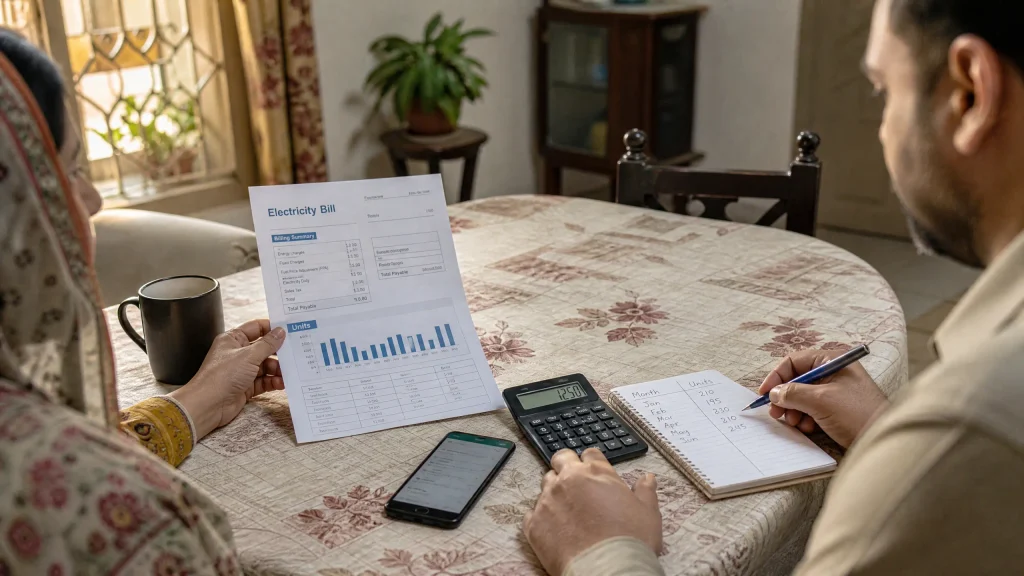
A crucial point most bill calculators bury: these rates are not “the first 100 units at X, next 100 at Y.” Once you cross into a higher slab, your entire month’s consumption is billed at that slab’s rate. Use 210 units instead of 190, and you don’t just pay more for the extra 20 — your whole bill jumps to the next bracket. That’s the single biggest reason a small increase in usage produces a disproportionately large increase in cost.
Protected Consumers (Average ≤200 Units for 6 Months)
| Monthly Units | Rate per Unit (Rs) | Fixed Charge |
|---|---|---|
| 1 – 100 | 10.54 | Rs 200/month |
| 101 – 200 | 13.01 | Rs 300/month |
Lifeline Consumers (Consistently ≤100 Units)
| Monthly Units | Rate per Unit (Rs) | Fixed Charge |
|---|---|---|
| 1 – 50 | 3.95 | None |
| 51 – 100 | 7.74 | None |
Lifeline and protected status is calculated on your average consumption over the last six billing cycles — not just the current month. If that average tips past 200 units even once, you’re reclassified as a non-protected (unprotected) consumer, and the higher slab rates above apply from your next bill onward.
Time-of-Use (TOU) and Prepaid Domestic Rates
If your sanctioned load is 5 kW or higher, FESCO bills you on a Time-of-Use structure rather than flat slabs:
- Peak hours: Rs 46.85 per unit
- Off-peak hours: Rs 34.53 per unit
- Fixed charge: Rs 675 per kW per month
Prepaid (token-based) residential meters are simpler — a flat Rs 42.12 per unit, plus the same Rs 675/kW fixed charge, regardless of how many units you consume in the month.
Fixed Charges, Minimum Charges, and Extra Costs on Your Bill
The per-unit rate is only part of the story. Every FESCO bill also includes:
- Fixed/demand charge — billed per kW of sanctioned load, ranging from around Rs 200/kW for lower protected slabs up to Rs 675/kW at the top domestic bracket.
- Minimum monthly charge — Rs 75 for single-phase and Rs 150 for three-phase connections (applies to lifeline consumers who don’t pay a fixed charge).
- Fuel Price Adjustment (FPA/FCA) — a monthly correction, typically Rs 2.5–4 per unit, that reflects the real cost of fuel used to generate electricity that month. This is why your bill changes even when your usage stays identical.
- GST — 18% on the energy and fixed charges.
- Electricity Duty — roughly 1.5%.
- TV licence fee and other surcharges — small fixed amounts added per connection.
Together, these can add 25–35% on top of the base slab rate, which is why the number on your bill is always higher than “units × per-unit rate.”
Commercial and Industrial Rates in the FESCO Region
Faisalabad’s textile and manufacturing base means commercial and industrial tariffs matter just as much as domestic ones locally.
- Commercial connections: are typically billed around Rs 27.50 per unit on a flat variable rate with roughly Rs 300/kW fixed charge, or on a Time-of-Use structure with peak rates in the low-to-mid Rs 30s per unit and off-peak in the mid Rs 20s, depending on sanctioned load and connection type.
- General service / industrial consumers: fall under NEPRA’s uniform industrial tariff, with base rates generally in the Rs 40–45 per unit range before adjustments — though large industrial units on B-series (bulk supply) tariffs negotiate connection-specific terms with FESCO based on load and voltage level.
Because commercial and industrial billing depends heavily on your specific connection category (A-1, A-2, B-1, B-2, B-3, etc.) and sanctioned load, the safest way to confirm your exact rate is your last paid bill or FESCO’s commercial customer services desk.
Worked Example: How a FESCO Bill Is Actually Calculated
Take a non-protected household using 350 units in a month:
- First 100 units × Rs 22.44 = Rs 2,244
- Next 100 units (101–200) × Rs 28.91 = Rs 2,891
- Remaining 150 units (201–350) × Rs 33.10 = Rs 4,965
- Energy charge subtotal: Rs 10,100
- Add fixed charge, FPA (~Rs 3/unit × 350 = Rs 1,050), GST (18%), and electricity duty
Final payable amount typically lands around Rs 13,500–14,500 once every adjustment is added — nearly 35% above the raw energy charge alone. This is exactly why two neighbours using the same units can see different totals: their FPA month, connection type, or sanctioned load may differ.
Why Your Bill Increased Even Though You Used the Same Units
This is the most common complaint FESCO consumers search for, and it almost always comes down to one of these:
- You crossed a slab boundary. Going from 195 to 205 units doesn’t add 10 units’ worth of cost — it can re-rate your entire bill at a higher slab.
- FPA moved. Fuel costs are notified monthly and can swing your per-unit rate up or down without any change in your habits.
- Your protected status changed. If your 6-month rolling average crossed 200 units, you lose the subsidised protected rate.
- Seasonal or periodic NEPRA revisions. Tariffs are rebased annually (typically each January) and can be adjusted mid-year through government relief packages or review petitions.
Practical Ways to Lower Your FESCO Bill
- Track your running total mid-month. Staying just under a slab boundary (100, 200, 300 units) can save far more than the “extra” units would suggest.
- Shift heavy appliance use to off-peak hours if you’re on a TOU or prepaid meter — washing machines, water heaters, and iron use during off-peak windows cost noticeably less.
- Service your air conditioners before summer. A poorly maintained AC can use 20–30% more electricity for the same cooling output — the single biggest swing factor in most Faisalabad households’ bills.
- Switch remaining bulbs to LED and unplug standby devices — small, but they add up over a billing cycle.
- Consider net-metered solar if your average consumption regularly lands in the 300+ unit slabs, where the per-unit rate is highest and the payback period is shortest.
Frequently Asked Questions
What is the current FESCO per unit rate for domestic use?
It ranges from Rs 3.95 per unit for lifeline consumers (up to 50 units) to Rs 47.20 per unit for non-protected consumers using more than 700 units a month, with several slabs in between.
Does FESCO set its own electricity rates?
No. FESCO, like every distribution company in Pakistan, bills according to the tariff NEPRA notifies. FESCO handles billing, metering, and distribution — not pricing.
How do I know if I’m a protected consumer?
Check your last six FESCO bills. If your average monthly consumption across all six stayed at or below 200 units, you qualify for protected rates. Your bill usually states your consumer category near the top.
Why did my bill nearly double for a small increase in units?
You likely crossed a slab threshold (commonly 100 or 200 units), which re-rates your entire month’s consumption at the higher bracket — not just the extra units.
Is the Fuel Price Adjustment the same every month?
No. FPA is notified separately each month based on actual fuel costs and can increase or decrease your per-unit charge independent of the base slab rate.
Where can I check my exact FESCO bill online?
Through FESCO’s official online bill portal, where you can view, download, and verify your current bill using your reference or consumer number.
Final Word
FESCO’s rates are really NEPRA’s rates, applied through FESCO’s billing system — and they change more often than most consumers realise, through slab crossings, monthly FPA notifications, and periodic rebasing. The numbers above reflect the most recent notified tariff, but electricity pricing in Pakistan is revised frequently, so always cross-check the figure on your latest paid bill or FESCO’s official portal before making financial decisions based on it.

Hamza Bilal writes for FESCO Online Bill, sharing simple and accurate guides to help FESCO consumers check, understand, and pay their electricity bills online without any hassle.